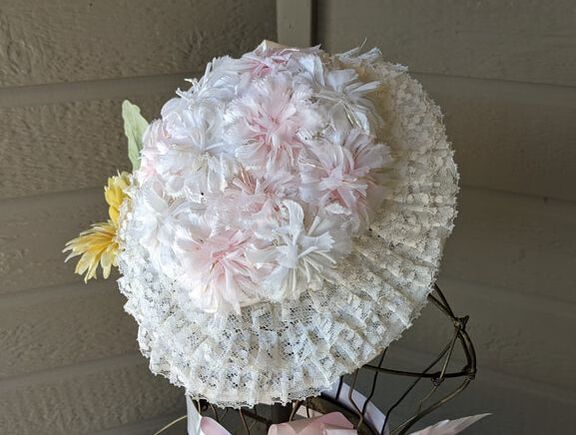
 Hats are lovely to look at. Many are one-of-a-kind handmade works of art, so it's no surprise that people want to display them. The internet is bursting with articles in which people extol the beauty of arraying your hats on a wall instead of art. For me, though, there's a problem: hats fade. I have seen too many hats in antique and thrift stores that have that washed-out, uneven look of a hat exposed to too much sunshine. I even own a few. The Orange Ribbon and Cello Straw Beret, which was purchased online, arrived with the band a deeper orange than the top, as if it had been hung on the wall--the outward-facing top faded, while the band, curled under and protected from the sun, did not. And the once green hat a friend got for free at a garage sale has faded so much it appears white, except for the green veil, which was obviously less prone to fading. Mind you, I am not perfect. I have so many hats I don't have room to store all of them boxed up. So I hang some on some hooks behind the door in the spare bedroom. Most of these hats are modern hats, not particularly rare or valuable, so I feel less bad about exposing them to the limited amount of light that makes it back there. But, as you can see, the jumble of hats is a far cry from the artful displays on Pinterest. 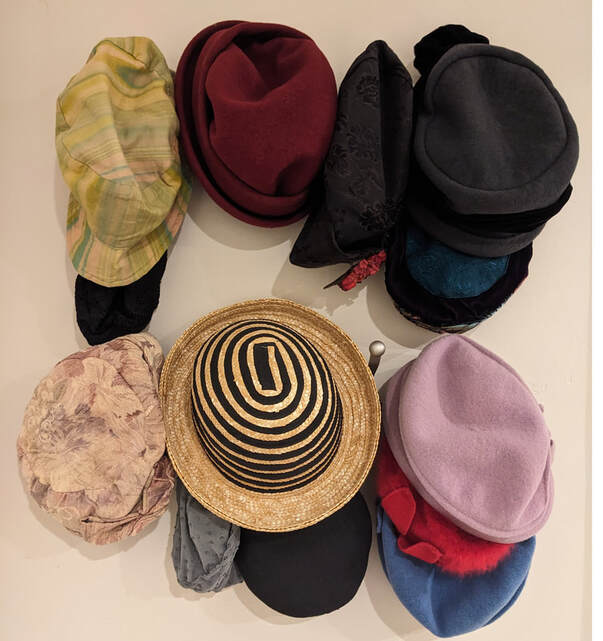 Longtime blog readers will recognize most of these hats. There is only one up there that has not been featured in The Hat Project--maybe I'll write that hat's story one of these days. Another way I display hats is on the hat stand I own. The stand operates as a staging area. I often place the next hat I'm planning to wear there for easy access. Hats sit on the stand for other reasons too. For example, the giant black hat is so big it doesn't fit in even my largest hat box and spent several weeks on the hat stand while I tried to decide what to do with it (it ended up in big plastic bag on a closet shelf). Here's how the stand looks right now: 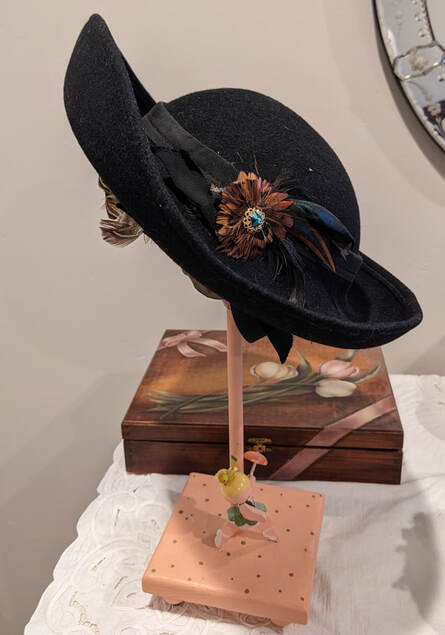 Turbo fans of this blog might notice that I have never worn this hat. It was in a load of hats from a friend, and though I like the shape, it has some condition issues. I have to decide whether to wear it as-is, try to address the problems, or give up on it and pass it along. Hats on the stand are exposed to some sunlight, but the hat stand is always a temporary destination. So, what prompted this blog? After all my protestations, I bought a vintage hat simply to display. And worse, it's not even indoors, but outdoors where it will be prey to sun, wind, and dirt. I know I am basically choosing to destroy this old hat that has survived for decades. But the hat was not in pristine condition and was perfect for what I wanted. A couple of years ago, I got the idea that I would like to use a wire dress form in my yard. I'd seen a few in antique stores and, the same way I made planters from a bird cage and a typewriter, I thought I could make a succulent display on a wire dress form. Then I came to my senses. I have a birdcage flower planter because the deer eat EVERYTHING. To them, succulents are...succulent. But I could use silk flowers So, I kept my eyes peeled in antique stores until I found what I was looking for about two years ago (the picture is from the day I brought it home). 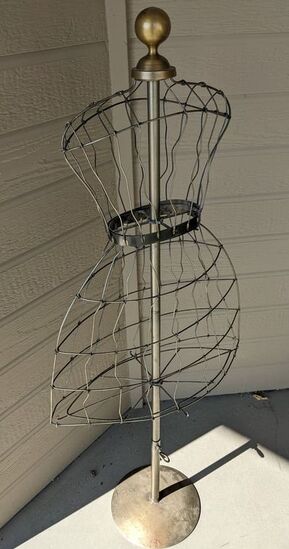 My vision was to cover it in yellow and white daisies, but the wire itself was so cute, I only ended up putting on flower accents. Instead of the yard, I put it on the porch. And for the finishing touch, I ordered a straw hat to decorate and put on top. Only problem was, my dress form is child-sized, making the cheap straw hat I bought way too big. Ever since then, I have been on the lookout for a child's hat to complete the dress form that sits on my porch. And a few days ago, on one of my walks, I spied a small hat through an antique store window. I went inside and tried it on to make sure that yes, it was a child's hat and not an adult's. It is made of rows of lace and topped with artificial flowers. The lace has yellowed quite a bit, the ribbons are not pristine, and the hat is slightly misshapen. Given all that, and its cheap ($13.00) price, I thought I could put it on my form. It's not like me to sacrifice an old hat, but I'm doing it, and enjoying the results this spring. 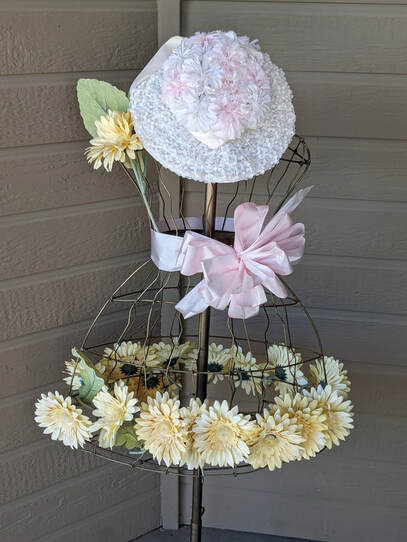
0 Comments
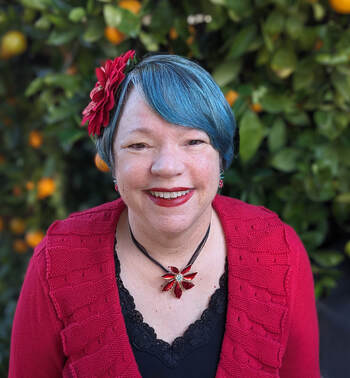 “The sun is shining, the grass is green, the orange and palm trees sway…” The song “White Christmas” begins with the singer describing Christmas in Southern California—and wishing for the snowy weather of their Christmases past. And though I have always lived in California, I have usually spent the holidays in the northern part, which is, if not cold, cooler. You don’t see snow, but there is usually a nip in the air. But this year I am in Southern California for the holiday. It’s nearly 70 degrees and brightly sunny on December the 24th. And though I am not, as the song says, “longing to be up North,” since I am with family, I am finding the holiday weather a bit of a novelty. I didn’t even bother to bring my fancy Christmas coat with its faux fur trim, which I typically wear on Christmas Eve. (I am wearing it with the gray Parkhurst hat in an early Hat Project post). However, I do like the warm weather and the chance to wear my newest holiday fascinator, the sparkly poinsettia. No need for the fuzzy red beret that I often wear Christmas Eve. My ears are warm enough! I originally bought this fascinator with a headband (similar to my other holiday fascinator The Christmas Tree Fascinator). However, the band provided by the Etsy maker pinched a bit, so the proprietor was kind enough to replace it with a clip. Does the poinsettia still qualify as a hat? Well, Ascot requires hats to be four or more inches, and the flower is nearly five, so I’m counting it! I got this poinsettia because I wanted a festive hat that was less goofy than the Christmas tree, something I could wear to church and even in concert without feeling too kitschy. I wore this poinsettia to both of those this holiday season. In the spirit of Christmas in Southern California, I took the first picture in front of an orange tree. Also, as bonus, here is a picture of the poinsettia hat and my poinsettia necklace (really a pin on a ribbon) while I'm posing with an actual poinsettia. It’s warm enough here that poinsettias grow in the ground and bloom naturally in December. That seems very Christmas-y to me. 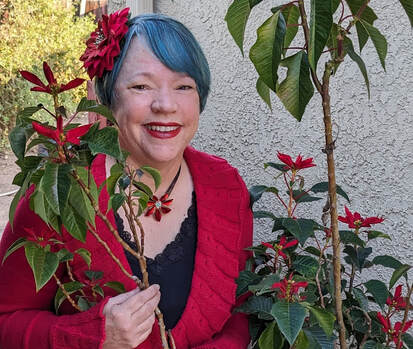 As the song says, “May your days be merry and bright” this holiday season and into the new year. 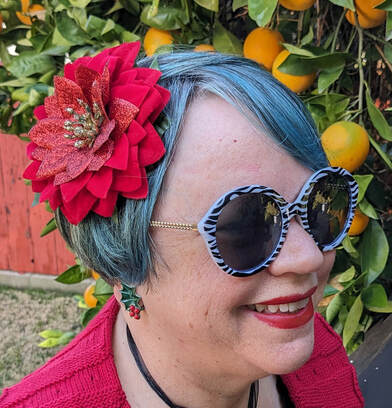 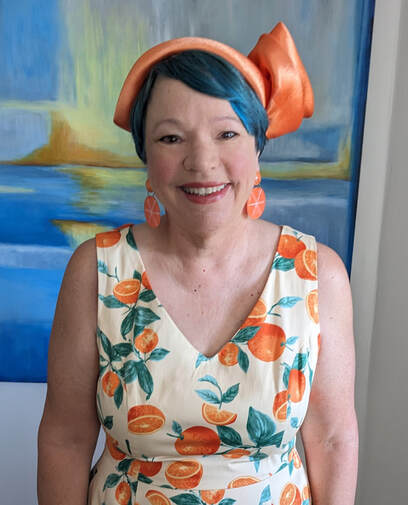 I buy very few hats these days. As my collection has started to spill out of my closet space (I still don’t have a box big enough for the giant black hat, and other boxes are near capacity) I have concentrated on hats that fill a hole in my collection. I don’t need any more small black hats, though I love them. I only had one orange hat, the Orange Ribbon and Cello Straw Beret. I had picked it out online, and my husband bought it for me for Christmas. But as sometimes happens when buying online, the hat had some issues that weren’t disclosed. It had obviously been displayed at one time and was faded in some areas. The weave had stretched out over time. And, finally, it had a musty odor. I didn’t notice the odor at first and wore the hat on the day we took the pictures. But the next time I went to wear it, after it had been confined in a small box for a few months, the smell was very noticeable. Hats are delicate. Some can be steamed and even reshaped, but others cannot be because of their materials. I took a small chance and washed the beret. However, even washing it did not get rid of the smell. Given its fading, I decided to let that hat go and start looking for another orange hat. I had my eye on this satin orange hat on Etsy for a while. Vintage orange hats are relatively rare; the color orange goes in and out of style (unlike, for example, black and white). Fewer orange hats exist, especially from the fifties and early sixties. I had bought the dress a year or so ago and was dying to get an orange hat to match. It’s a smashing combo, and though not completely flawless, the hat is odor free and looks as if has seldom been worn. This kind of hat is sometimes called a half hat, and it’s easy to see why-- it doesn’t cover the whole head. This one has three sections, the center pleated one and two others on the front and back that provide a bit of a halo and allow for a peek-a-boo look at my blue hair! 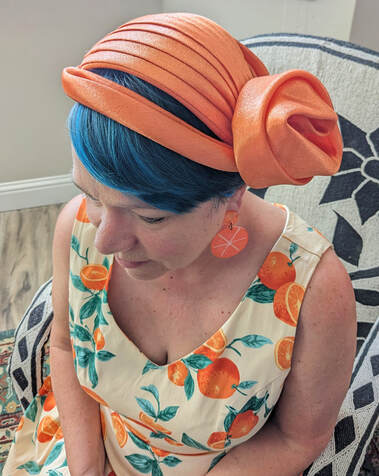 I’m guessing this hat dates from the mid-fifties. Take a look at this hat that Queen Elizabeth II wore in 1954. Notice the side pom pom that is similar to my orange satin hat’s flower. But the rest of the shape is what is known as an eggshell shape (also easy to see why). I only have one eggshell hat, and I felt like an idiot when I wore it! But the queen always wore her hats with panache. 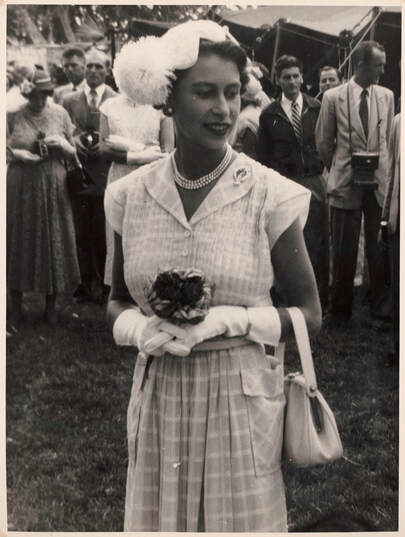 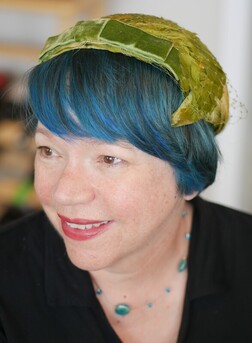 As I wrote in my last post a few months ago, I finally did something I’d wanted to do for a while and dyed my hair blue. I love the color, but it does have an impact on the look of my hats. As I wrote last time, some simply become more startling from the extra contrast. Others, however, look better or worse, depending on the color. Better This brown hat looks better with the blue hair. When I wear brown hats, such as this one or the brown tweed pillbox, the hat color blends in with my hair color so that you don’t really see the hat well. But with the blue, the brown hat pops in a new way. 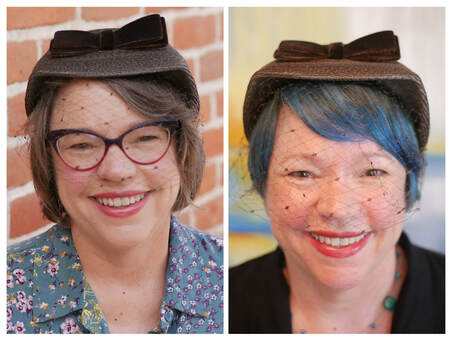 In addition, as you will see later, a small black hat can also benefit from the greater contrast. Worse The hats that become problematic are the colorful ones. For example, this blue hat looks a bit greyish next to the bright blue hair. In fact, all my blue hats are blueish grays, so none of them looks that great with the bright dyed hair. 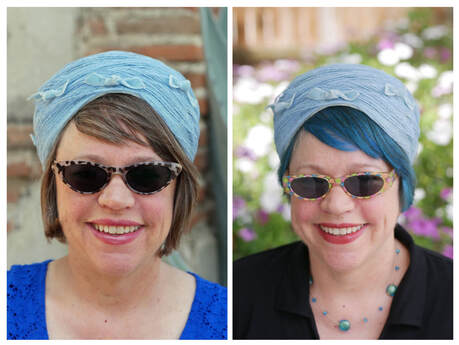 The picture doesn’t quite reflect the situation, but this green feathered hat looks more olive when contrasted with the blue. 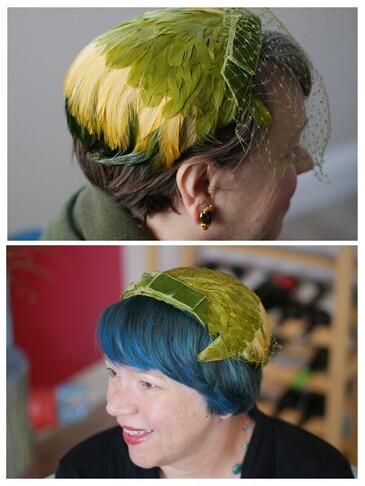 And the blue hair with a red hat is pretty startling. The only way to pull it all together is with the perfect outfit! This combo wouldn’t work as well without the red and blue shirt (see more of the shirt in The Orange Ribbon and Cello Straw Beret ) 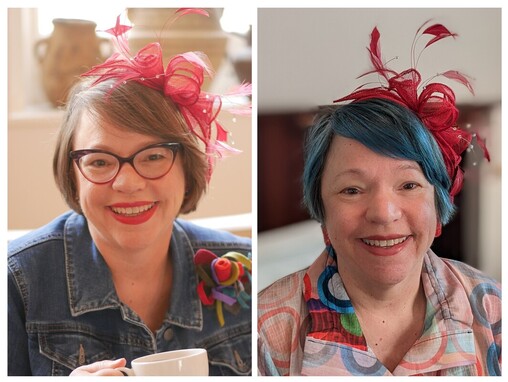 Fading The blue dye is what is known as semi-permanent—meaning it washes out over time. So my hair fades to turquoise before I get it dyed cobalt again. Here are a couple of pictures where the bright blue has faded to a more subtle color. In the first one, my turquoise hair matches my turquoise dress. (The same hat and dress are in the original Madame X hat post.) I also feel the turquoise hair highlights the black hat better than my natural color does.  And finally, here is another red hat picture, in which my hair has faded to just hints of light blue. In this case, I felt no need for an outfit that pulled together the blue and red. The subtle blue doesn't overwhelm or fight with the red. 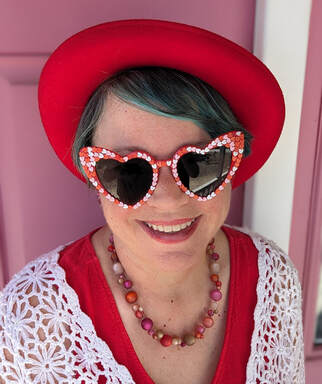 Will I have blue hair forever? I doubt it. But I'm enjoying all the permutations, and their effects on hats!
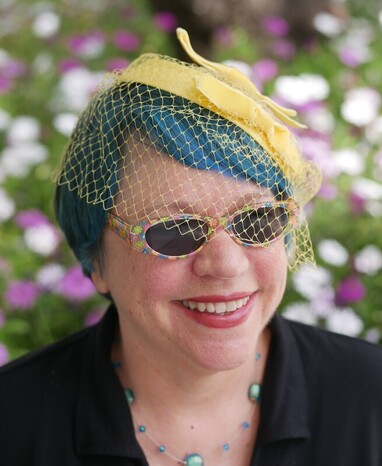 Recently, I dyed my hair blue. I first thought about dying my hair a bright color during college. It was the eighties, the era of Cyndi Lauper and Boy George. People in my dorm had bright hair, and I thought it might be fun to have it too—if I were a completely different type of person. Blue, I thought. I’d go for blue. If I were someone more bold, more interesting, more unusual. But someone like me should stick with brown. And I more or less did (with some occasional periods of highlights) until this year. The Hat Project gave me the courage to wear the fabulous hats I’d been collecting for years, and wearing the hats turned out to be more fun that I would have predicted. So I decided to fulfil another longtime dream and dye my hair a bright color. I started with some pink streaks. First, my hair stylist gave me highlights, then we experimented with a couple of pinks, gilding my hair all over with a reddish-pink glow. The effect was fun, but subtle—bright for a week or two, then little hints here and there. A couple of times, in a middle of a conversation, a person I hadn’t seen for a while would say “Ann, you have pink in your hair!” It wasn’t something that was always immediately noticeable.  Subtle pink hair I put in the pink off and on for several months. (If you look carefully, you can see it the picture of the Giant, Glamorous Black Hat.) I always thought, “Maybe this is the last time, then I’ll go back to my natural hair.” But then I decided that before I quit, I would go blue, as I had always wanted to. Forty years after college, I was finally a bolder person.  Freshly dyed blue hair The blue was quite a contrast to my usual color. It was both darker and brighter than the pink, and initially the dye turned the unhighlighted parts of my hair almost black. The effect was like how comic artists draw dark hair with blue highlights. I had superhero hair! 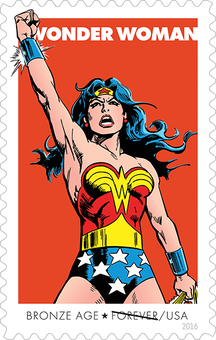 I loved it immediately. But I also discovered that my darker, intensely colorful hair affected how my hats looked. Some benefited from the extra contrast, some looked worse, and some just looked different. For example, this yellow ring hat really pops against the blue. 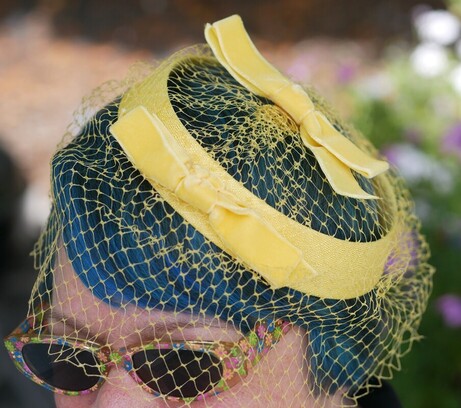 Look at that contrast! 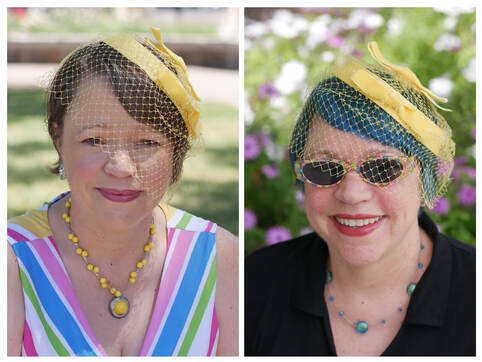 Yellow hat side by side comparison Not better or worse, just a different look, with a bit more emphasis on the hat. This white ring hat also seems brighter on the blue hair: 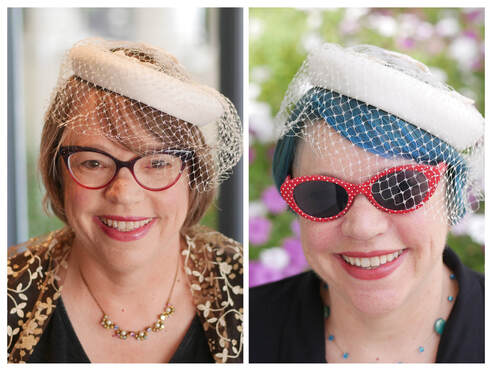 In the original picture, the golds of the necklace and scarf match the hair color and give the pallet harmony and sophistication. With the blue hair the white hat seems stark against the black, even with the hint of blue necklace. The veil becomes more prominent. Add in the red polka-dot sunglasses, and the look becomes accidentally patriotic. Now I know what hat to wear on the Fourth of July, assuming my hair is still blue then!
The hair color doesn't make these hats better or worse, just different--with more pop and less subtlety. Stay tuned for the next post, where i will show some hats that blue hair improves and others that blue hair worsens!  “Look, they have typewriters,” my husband said, pointing at the yard sale across the street. We were out for a walk, a habit I took up during the pandemic when I was dying to get out of the house. (If you want to see photos from my walks, check out my Instagram at @annhillesland). A few years ago, I had wanted an old typewriter to use as a plant holder, and even though we found one, we haven’t gotten out of the habit of looking for them. So we walked across the street, as we got closer, I saw something that excited me more than typewriters—hat boxes! 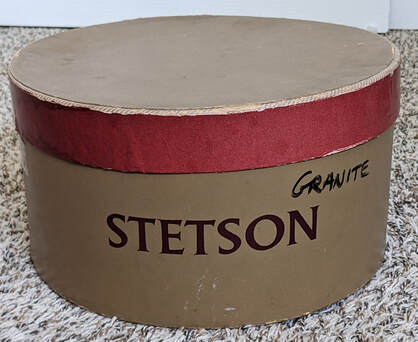 This box seemed promising—even though it was taped together, it was branded Stetson. Inside, I found a fedora. (Though the brim is narrow for a fedora, I think it is one, but I welcome more educated input). Despite owning wide variety of hats, I have never had a fedora before. I try them on sometimes, but they don’t usually appeal to me. Like cowboy hats, their style usually doesn’t suit mine. Still, I liked this one—its basic black, its shy little red feather. A couple were having the yard sale—the man said the hats belonged to the woman. When she saw my interest, she explained that the man, knowing she liked hats, would buy her one whenever he was in a hat shop and found one in her size. My husband, knowing I wanted the hat but was hesitating, encouraged me to get it. He actually bought it, since I had not brought any money on this neighborhood walk. So, he, like the man at the yard sale, was showing his love for me by buying a hat. Vintage hats are relics of a certain time and place. Often vintage hats have labels from particular milliners or hat stores, often including the place they were made or sold. So many old hats are not mass-produced, but hand-made or hand-decorated visions of an individual artist. In that way they are often more unique than many other pieces of vintage clothing. Even though this hat is mass produced, made by probably the most famous American hat company, it's stamped “Square Stores for Men, 2787 Milwaukee Ave, Chicago” in gold inside on its leather hatband. This store no longer exists. But the hat does, a memento of a time and place that has vanished. And what could be cooler than a fedora from Chicago? I wish I could have worn it to a blues club, but it turns out wearing it on a walk along the bluffs by the Pacific Ocean suited it just as well. And for those wondering about my typwriter planter, here it is. I keep it in my writing room, next to my modern computer to connect me with writers of the last century, as the hats connect me to the past. 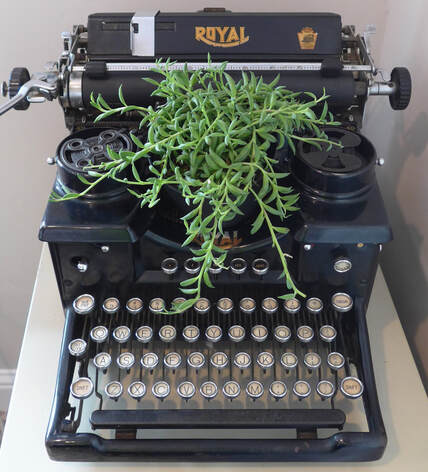  I’m not much for large hats. I’m a fan of vintage close hats and half hats that perch on my head, little decorations. I always thought my navy and white hat and the blue straw hat with sequins were large hats. But when Mary, my pool friend, gave me a bag of hats, I found this black hat that was, for me, enormous. Wider than my shoulders. Of course, much bigger hats exist, but this hat is the biggest I have ever worn. When I put it on, my husband joked, “Will I be able to sit next to you in church?” “It’s my social distancing hat,” I replied. “No one can get within six feet of me.” I bumped the brim into the closet door, the car roof, my husband. I wondered why I couldn’t see to put on my lipstick and realized the big brim was shading me. At church I sat on the far aisle seat so I wouldn’t block anyone’s view of the pulpit. However, an enormous hat has a certain glamor, as more than one church member said, “You look like a movie star!” Maybe that’s not a coincidence. This hat is from Fred Hayman Beverly Hills. In the 1960s, Hayman managed the Beverly Hilton hotel. In 1961, he and his partners (whom he soon bought out) started a clothing store called Giorgio of Beverly Hills near the Beverly Hilton, on Rodeo Drive. According to Wikipedia, at that time Rodeo Drive was “a very ordinary street.” He was a pioneer long before the luxury brands moved in, to the point where his LA Times obituary called him the “godfather of Rodeo Drive.” Wikipedia says the store “had a reading room, pool table and oak bar, so that men could amuse themselves while the women shopped.” Truly a visionary! When he sold the Giorgio of Beverly Hills brand to Avon in 1987, the store became Fred Hayman Beverly Hills and remained open through 1998. I can’t date this hat within those twelve years, but to me it has a distinctly late 80s vibe, a la Joan Collins in Dynasty. 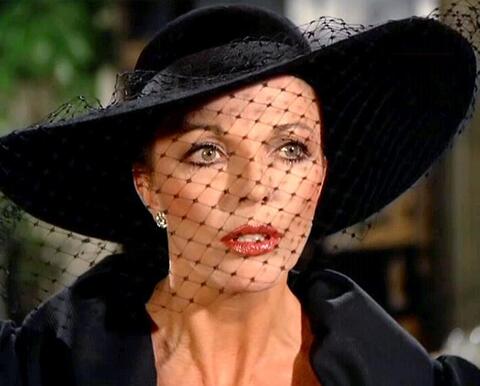 When I first tried out the hat, I felt sure that such a large hat would end up in my “donate” box (which I have yet to donate and from which keep pulling hats out to wear!). But it’s hard to resist the glamor of a movie star hat, which is probably what Fred Hayman was banking on all along. 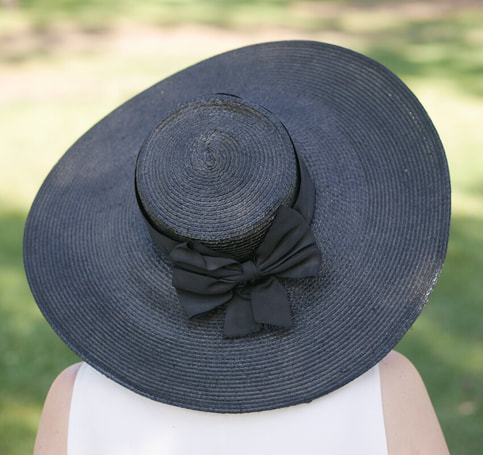  “Look at you, lady!” “Love the hat!” The compliments started when I walked in the door at church. I was taken by surprise because everyone in church is used to seeming me in hats. In fact, if I don’t wear a hat, people claim they can’t recognize me. I usually get some positive feedback, but this reaction was more than normal. Even when we stopped by the Italian grocery store after church, a guy in the parking lot complimented me. The hat’s size and color attracted the extra attention (well, that and maybe my coordinated red blouse, black pencil skirt, red heels, and black jewelry). All hats say, “Hey, look at me!” to some degree, but this hat shouts it. In general, I prefer more subtle (smaller) hats, but wearing a daring one is fun too. This hat, like the red cartwheel hat, came in the Hefty bag of hats a friend from the pool passed on. It caught my eye immediately. I enjoyed it because it seemed an excellent example of 80s hat style, with its large brim and bold contrast in color and materials. However, my husband didn’t have the same appreciation. “It looks like a tire,” he said. (He has compared other hats to spaghetti and Jiffy Pop, as well as a bird's nest with bows on it.) He hasn't been wrong. 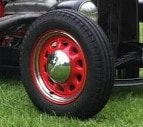 There is a resemblance! When I got the hat, it had what I at first glance thought was a long hatpin stuck in it. 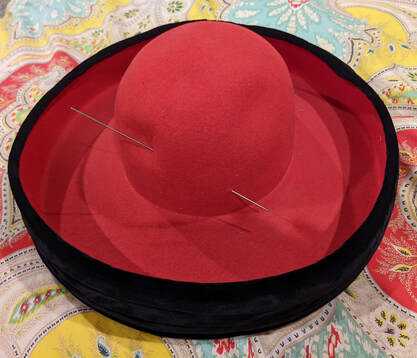 However, when I went to remove it, I found it was glued in. It must have been a support for some long-gone decoration, possibly a large black feather (which would have been very in keeping with the era). Or perhaps something even more unusual. Here’s a picture of a hat from the same era by the same maker (Adolfo II) with an array of coins as decorations. If you remember the 80s (“Greed is good”) a money trimming is also era-appropriate. 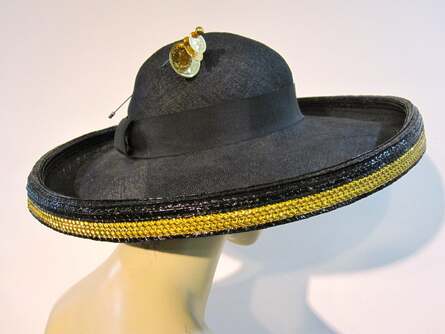 Photo from 1stDibs In any case, once I removed the metal stick, I pinned on a sparkly flower broach. Not era-specific, but much more me! 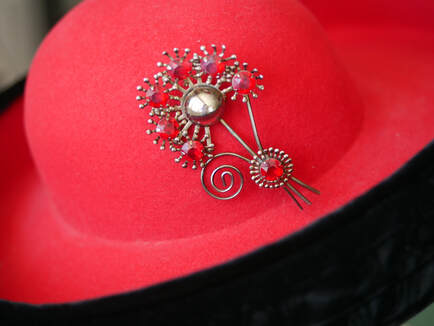 A word about the earrings. These black earrings used to be my mother’s. She gave them to me about a decade ago, including a note saying that her parents bought them for her many years previously and that she had enjoyed wearing them very much. She said they were called Apache tears, which I discovered is a kind of obsidian (read the sad legend behind the name on Wikipedia ). According to the website Crystal Stones, the stone “is best known for its comforting and supportive energies during times of grief and mourning.” My mother passed recently. I wore these earrings in her honor, but if you believe in the properties of stones, perhaps they brought me comfort as well. I know that rereading the note from her, seeing her handwriting, and hearing her voice in her written words certainly did. 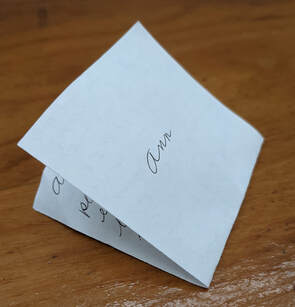 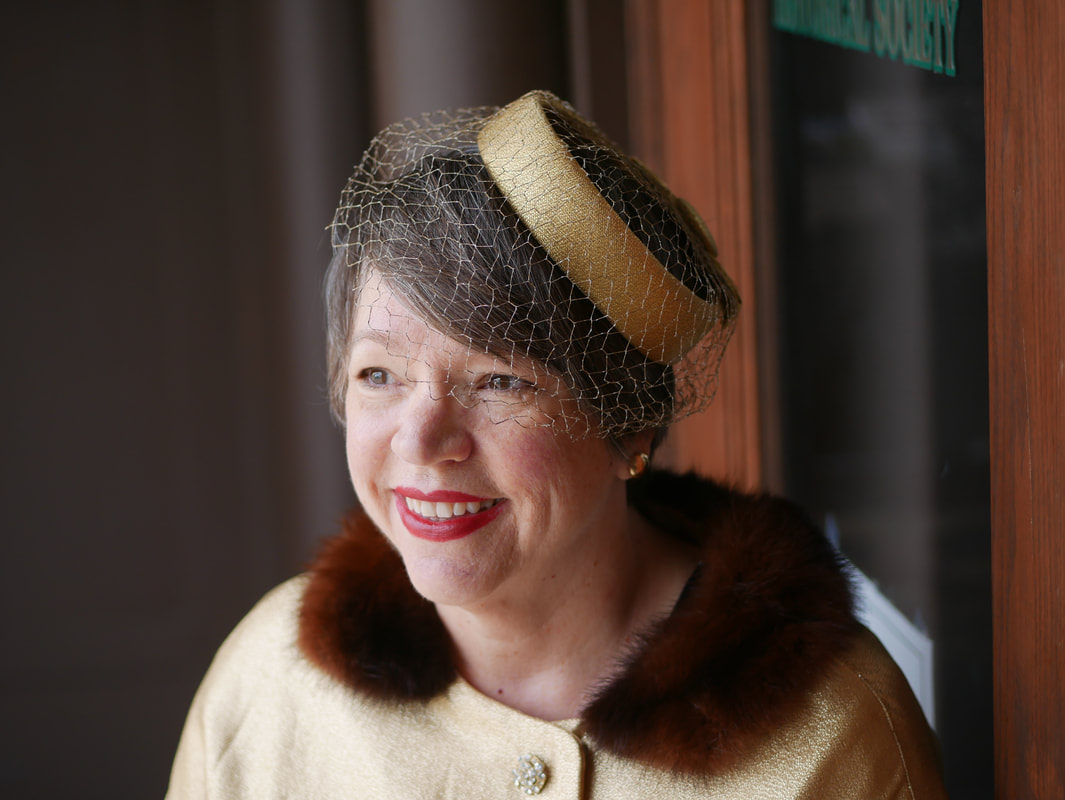 "I have a hat for you," my friend Bonnie said when I met up with her and the rest of the JewelTones to film our "Chattanooga Choo Choo" video. When I had purchased the gold lamé coat, she had hinted that she had the perfect gold hat for it. I admit I was a bit apprehensive. "Gold hat" could go wrong in a lot of ways--a quick Google search pops up cowboy hats, top hats, bowlers, and (yikes!) baseball caps. Even vintage gold hats can be over-the-top, featuring swooping bows and lines of sequins. I vaguely pictured a late sixties turban hat that would be best worn with a flowing caftan and giant hoop earrings. Instead, nestled in the tiniest little hatbox (printed with little pink chicks) was this gold ring hat. It did indeed go perfectly with the coat--from just the same era. The veiling is original, and looks to have tarnished over time, but the hat has lost none of its charm. Bonnie has given me a lot of hats over the years, and this one is destined to be a favorite! 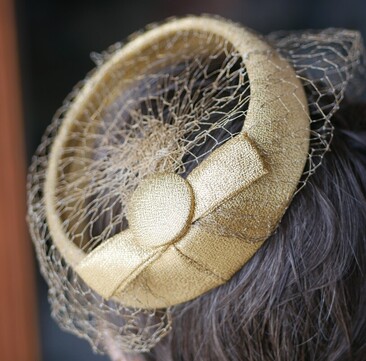 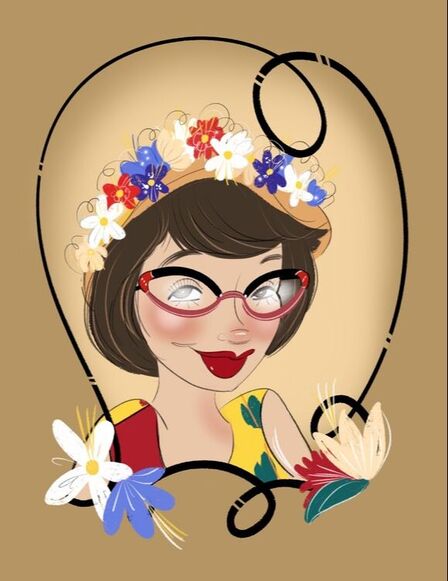 This year, I got a super fun Christmas gift: a cartoon version of me by artist Lauren Kurtz, otherwise known as Coppertop Ink. As her website says, she draws "vintage style cartoon cuties." I started following her on Instagram after seeing one of her drawings of a woman in a vintage hat. Upon discovering that she does commissions, I thought it would be fun to have a picture to use as an avatar online. Both my husband and I have reached a point where we are difficult to shop for at Christmas. We both get stumped as to what the other wants. To be honest, I got him four items with chocolate in them this year. Also, sweatpants. He asked me for gift ideas, and I finally sent him the link to the website and a picture to use. It was very close to Christmas, and on Christmas morning, when he didn't say anything, I assumed I'd given him the idea too late, especially as he'd gotten me several other lovely gifts. But then, while he was visiting his parents after Christmas, and we were talking on the phone, he sent me the image. It was beyond what I had expected. I love the way she captured the hat and picked up the hat flowers in the frame. Here's the photo I sent, so you can see how she transformed me into a come-hither beauty. 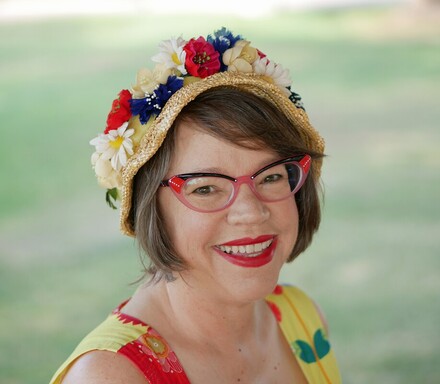 I've written before about how I gained confidence during the course of The Hat Project to wear even the wildest hats. I never would have gotten an artist to cartoon me before the project either. Getting the drawing was a fun-loving way to start the new year!
|
AuthorAnn Hillesland writes fiction and nonfiction and collects hats. In this blog she vows to wear (not just model, but wear out of the house) every one of her hats, blogging about their histories and their meanings for her. Archives
March 2024
Categories |
 RSS Feed